Published: Jun 30, 2017 by Lucy Tennyson
We breathe every moment, every day of our lives, but often pay little attention until we step into a yoga class. Breathing exercises (pranayama) are regarded as important as physical postures (asana) and are an important stage towards meditation.
In daily life, without being aware of it, it is easy to slip into upper-chest breathing, rather than utilising the full range of movement. If we are busy or stressed, we sometimes speed up our intake of air through rapid breathing into the upper chest, over using the muscles of the neck and upper body, which kick in to supplement the diaphragm’s action by moving the rib cage up and down more vigorously.
During a yoga class, the first step is to become aware of HOW we are breathing. After than, we can then explore how we feel when we change that pattern
A little anatomy
Think of your torso as a partly flattened cylinder divided into upper and lower sections. The upper section, whose walls are formed mainly by the rib cage, is called the thoracic cavity. It is almost entirely filled by the lungs, but it also contains the heart. The lower section, whose walls are formed mainly by the abdominal muscles, is called the abdominal cavity. It contains all the other organs of the trunk (liver, stomach, and so on), bathed in fluid. The divider between these two cavities is the diaphragm, a roughly dome-shaped sheet of muscle and tendon that serves as both the ceiling of the abdominal cavity and the floor of the thoracic cavity.
On inhalation, the diaphragm moves down, lifting the base of the rib cage and sternum, expanding the rib cage to the front, sides and back, creating a “chest breath.”
At the same time, the diaphragm presses downward on the abdominal cavity, which bulges forward, creating a “belly breath.”
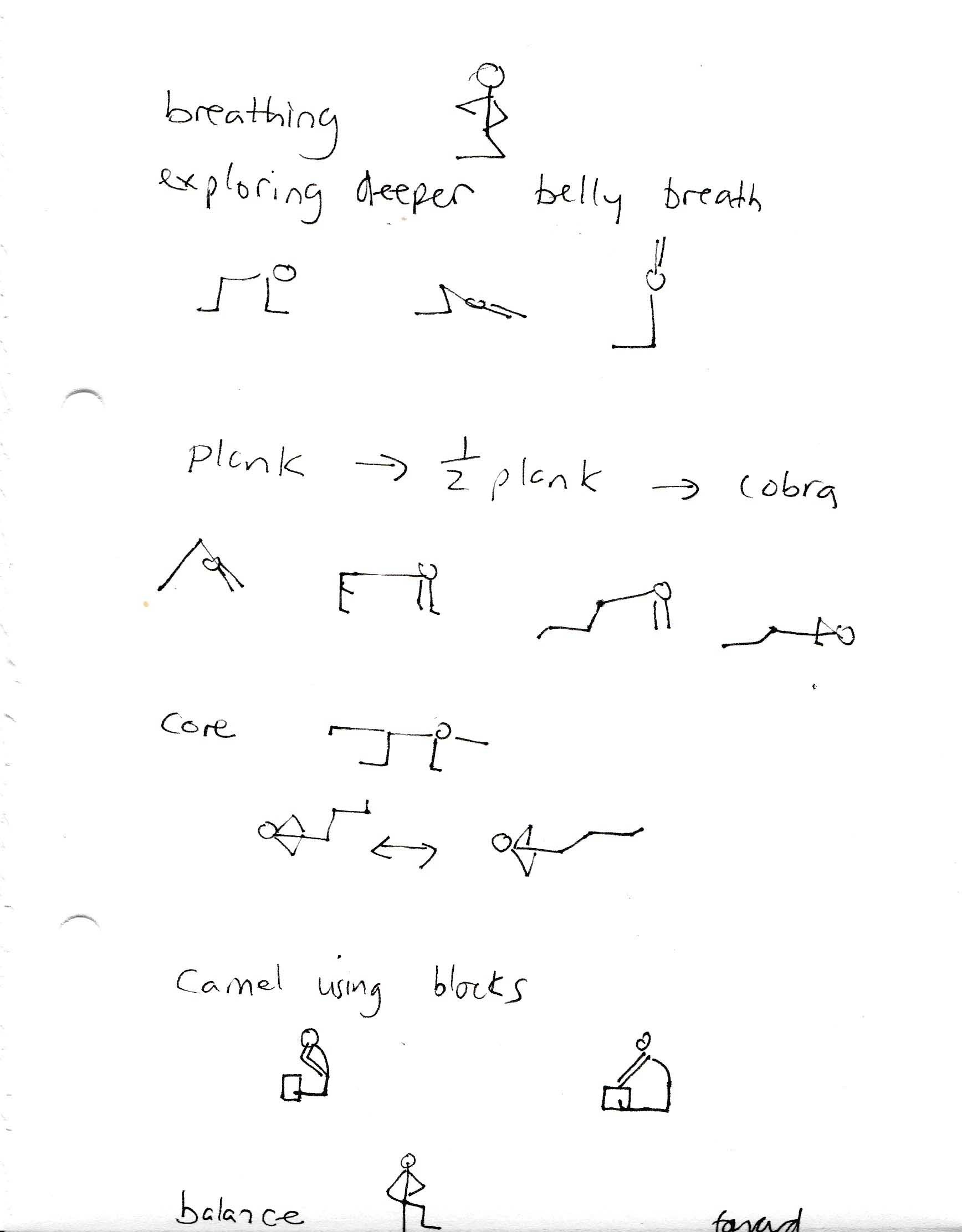
Breathe into your belly
First, soften as you exhale more deeply than usual, and then feel as if you are drawing the air in from the bottom by pushing your belly outwards on the inhale
Return to normal breathing after a few rounds.
Here is a reminder some of our class last week